


Vanuatu Health Research Guidelines
Information for applicants and for the review process
Download Guidelines1. Background
Introduction
The Vanuatu Health Research Ethics Committee (HREC) has developed the Vanuatu Health Research Ethics Guidelines in for Vanuatu to assist researchers who intend to undertake biomedical, public health or clinical research involving people of Vanuatu or research on issues relevant to the health of Vanuatu’s population.
All research with human subjects must undergo review by the Vanuatu HREC Committee and receive written approval before it begins. Regular reporting of project progress is required to maintain currency of ethical approvals.
Purpose
The purpose of this document is to set out the policies and procedures to be used by applicants and by the Vanuatu HREC in relation to research conducted in Vanuatu that involves health data and information, documents, or staff. They cover the processes associated with the approval, management of human health research projects and reporting requirements.
The guidelines are intended to ensure that any research is ethical to be undertaken, of high quality, respects human and cultural values, and is of benefit to the Vanuatu community and is accessible to the health sector and policy makers. Further, it is imperative that research does not place unnecessary burden on communities, the health sector or staff involved in health care delivery or policy.
The guidelines make clear what is expected of a researcher and of the health sector and hence assist the Vanuatu HREC to fulfil its responsibilities
Guiding ethical principals
To be ethically acceptable by the Vanuatu HREC, human research must demonstrate the values of research merit and integrity, justice, beneficence and respect inline with the:
-i. World Medical Association Declaration of Helsinki (2013) revision: https://www.wma.net/policies-post/wma-declaration-of-helsinki-ethical- principles-for-medical-research-involving-human-subjects/
-ii. International Ethical Guidelines for Health-related Research Involving Humans https://cioms.ch/wp-content/uploads/2017/01/WEB-CIOMS- EthicalGuidelines.pdf
2. Guidelines
1. Review by other research ethics committees
i. It is the responsibility of the Principal Investigator to identify any other relevant committees that may also need to approve the proposal. This may include other research committees located within Vanuatu, or human research ethics committees in the location of the Principal Investigator. Any such local requirements shall be brought to the attention of the Vanuatu HREC Secretariat when the proposal is submitted, and a copy of these approvals provided. It is preferred that other committee approvals are obtained prior to submission to the Vanuatu HREC. Importantly, approval from host institutions or other research committees within Vanuatu does not imply approval will be granted through VHREC without appropriate consideration.
ii. Other research committees in Vanuatu that may be consulted include:
a. Vanuatu National Vanuatu Cultural Council (for research that is of a cultural nature). The Vanuatu Cultural Research Policy provides guidance for projects that involve cultural research. "Cultural research" is defined as any endeavour, by means of critical investigation and study of a subject, to discover new or collate old facts or hypotheses on a cultural subject; the latter being defined as any anthropological, linguistic, archaeological, historical, or related social study, including basic data collection, studies of or incorporating traditional knowledge or classification systems (e.g. studies of the medicinal properties of plants, land, and marine tenure systems), documentary films and studies of introduced knowledge and practice.
b. Research and Development Unit, Policy and Planning Directorate, Ministry of Education and Training (for any research conducted in school settings).
c. Vanuatu Department of Agriculture and Rural Development (for any research conducted that involves agriculture).
d. National Advisory Board for Climate Change and Disaster Risk Reduction.
2. Community Considerations
i. All health research conducted in Vanuatu should consider the needs and potential impact of the research on individual participants and on the community - including those directly involved in the research project, or those impacted by the research process or outcomes. ii. The application should demonstrate:
ii. The application should demonstrate:
a. The steps taken to consult with the concerned communities in a culturally-appropriate way during all stages of the research project, including the design stage of the research as well as proposed consultation and engagement during the implementation interpretation and dissemination of research activities dissemination of research activities and findings.
b. The manner in which the results of the research will be made available to the research participants and the concerned communities
3. Research with vulnerable populations
i. Research with vulnerable individuals is often crucial in reducing social, economic and health inequities experienced by these groups.
ii. Researchers should not exclude participants from research simply because they may be vulnerable.
iii. Researchers should include the least vulnerable participants where it is consistent with their study aims.
iv. Researchers should provide all potentially vulnerable participants with appropriate support to help them make informed decisions about participating in a study.
v. Researchers must balance the rights of vulnerable individuals and groups and any potential benefits of their participation in research against any increased risk of harm.
vi. Researchers must consider pursuing special protection of vulnerable participants’ rights and welfare, while balancing this with respecting the autonomy of those individuals.
4. Research instigated by researchers outside of the Vanuatu Ministry of Health
i. If the project involves Vanuatu Ministry of Health staff or the use of data collected by the Vanuatu Ministry of Health, then written endorsement must be obtained from the Vanuatu Ministry of Health prior to submitting ethics applications. This is to ensure that the research does not create an undue burden on Vanuatu Ministry of Health staff, that the research is aligned with the priorities identified in the Vanuatu Health Research Agenda, and ensure that Vanuatu Ministry of Health staff have opportunities to develop research capacity and be involved in the research project where how it is deemed appropriate. Consideration of capacity building, employment, training and development for communities, participants, health sector staff and consumer groups should also be considered and outlined by applicants. Whilst some data collected by the Vanuatu Ministry of Health is in the public domain, the Vanuatu HREC considers it important to ensure Vanuatu Ministry of Health engagement and endorsement prior to the use of any such data.
ii. All projects should embed research capacity strengthening opportunities for ni-Vanuatu staff engaged in the research project. This includes invitation for co-authorship for publications and opportunities to present findings at regional and international conferences.
5. Criteria for exemption from ethical review
i. A research proposal may be exempted from review when:
a. It does not involve human participants; OR
b. The data (including health-care records and specimens) being studied already exist and are either publicly available or are recorded by the investigator in such a manner as to be unidentifiable by the investigator or any member of the research team; OR
c. Public officials are interviewed in their official capacity on issues that are in the public domain; OR
d. The data for the study are generated by observation of public behaviour; OR
e. The relevant activity is limited to public health surveillance or evaluation of health programmes carried out pursuant to statutory or regulatory requirements.
6. Period of approval
i. Approval is generally provided for a maximum period of 5 years duration, provided all annual reports are submitted. Substantial changes in protocol, recruitment, assessments, data collection methods, community information, consent, additional analyses to approved projects will usually require submission of a new application and not be approved via the amendment pathway.
7. Responsibilities of researchers
i. Research should only commence only after approval has been granted, or conditions for exemption established;
ii. The research can only be conducted in compliance with the protocol approved by the Vanuatu HREC.
iii. No deviation or changes should be made to the approved protocol or in following it, without prior approval of the Vanuatu HREC, except where immediate action is necessary to avoid harm to research participants. In such a case, the Vanuatu HREC should be informed promptly of the changes/deviations made, and the justification for doing so.
iv. The Vanuatu HREC should be informed of any changes at the research site that significantly affect the conduct of the trial, and/or reduce the protections or decrease the benefits provided or increase the risk to participants (e.g. closing down of a health facility at the research site or other impediments to obtaining access to health care that was originally available).
v. All serious, unexpected adverse events related to the conduct of the study/study product or unanticipated problems involving risks of harm to the participants or others should be promptly reported to the Vanuatu HREC and/or other relevant authorities, as required by Vanuatu HREC policies and applicable laws.
vi.The researcher submits written summaries of the research status to the Vanuatu HREC annually, or more frequently, if requested by the Vanuatu HREC. Failure to submit annual reports in a timely manner could lead to:
a. Revoking of ethical approvals
b. Halting or cessation of the project
c. Complaints to the host institution or funding body
vii. Researchers inform the Vanuatu HREC when a study is completed or prematurely suspended/terminated.
viii. Researchers have a responsibility to keep the research participants, and their communities informed of the progress of research by appropriate means, at suitable timeframes in simple and non-technical language, for example, when
a. The research study is terminated or cancelled
b. Any changes occur in the context of the research study that alter the potential benefits or risks
c. The research project is completed
d. Results of the research are available.
Data ownership
i. Individuals are the owners of their health data. Government, healthcare providers, private health insurance providers and clinical software developers/operators are the custodians of the patient data, not the data owners.
ii. The Vanuatu Ministry of Health reserves the right to request raw or cleaned data collected as part of a Vanuatu HREC approved project.
3. Application process
Step 1. Ministry of Health endorsement
If the project originates from a researcher not located within the Vanuatu Ministry of Health, relevant Vanuatu Ministry of Health personnel or committees must be consulted with, and the project must be endorsed prior to proceeding to ethical approval application stage. This includes for projects using routinely collected and publicly available data. If the relevant Vanuatu Ministry of Health personnel or committee is not known by the applicant, please contact the Vanuatu HREC Secretariat to request contact details (wtougen@vanuatu.gov.vu).
Step 2. Application form
All new applications should be submitted online using Vanuatu Health Research Online Ethical Review Application Form (click here). The following documents must also be uploaded (as PDF) as part of the application process:
a. MOH endorsement letter (for non-MOH applicants only)
b. Research protocol (following WHO guidance, see https://www.who.int/groups/research-ethics-review-committee/recommended-format-for-a-research-protocol)
c. Participant Information and Consent Forms (in English, French and Bislama)
d. Additional ethics approvals from other Vanuatu specific committees.
e. Overseas ethical approval, if relevant.
Step 3. Payment of fees
The fees for applications are:
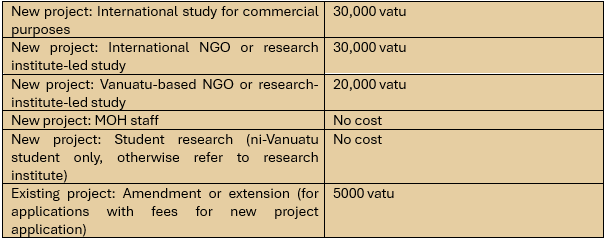
At this time, payments can only be made by cash or cheque. Please contact wtougen@vanuatu.gov.vu to discuss payment of fees.
Step 4. Review
The Vanuatu HREC seeks to conduct review and decision-making within one month of project submission.
Step 5. Outcome
The MOH HREC Secretariat will communicate the outcome of the review to the applicant by email. Potential outcomes include:
i. Approved as submitted
ii. Approved conditionally; requires amendments and/or clarifications
iii. Not approved; requires additional information and/or rewriting
iv. Rejected
Step 6. Reporting
Mid-term reports should be provided annually and a final report should be provided within 3 months of completion of the report. The MOH HREC Secretariat will email the templates to the contact person of approved projects.
In addition, the researcher must provide a copy of any publications arising from the work to the Vanuatu HREC and publications must fully acknowledge the Vanuatu Ministry of Health, and the Government of Vanuatu and other organisations involved as appropriate.